
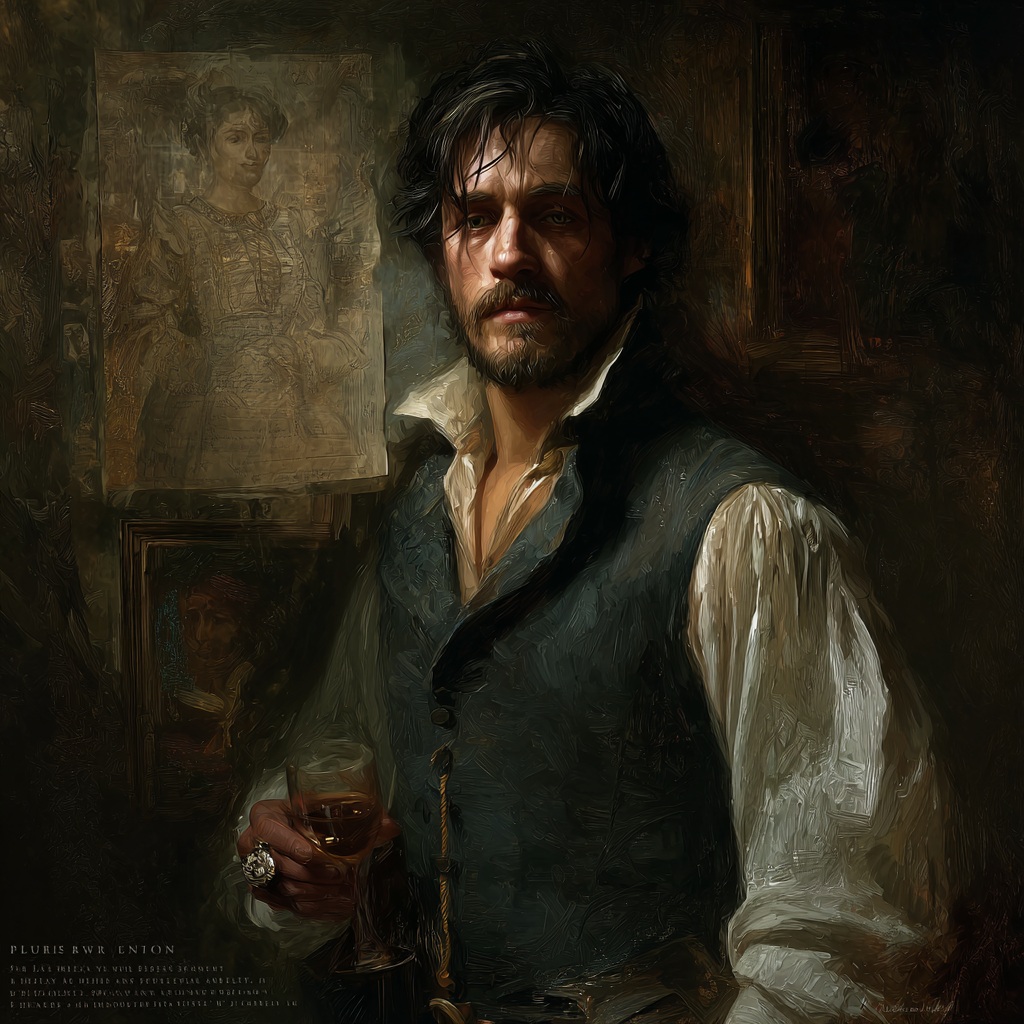
Alexander L. MacDougall

Alexander visited L’Ouvre whenever business drew him to his gallery in Paris. By now, he had lost count of how many times he had wandered through its halls. He always arrived at opening, when the morning light still felt tentative on the marble floors, and he remained until the last echo of footsteps faded at closing. For him, the museum was a reliquary of memories — artists he had known during their brightest years, some he had quietly supported; canvases that captured places and faces he longed for; rooms that still murmured fragments of his life.
His visits always settled a familiar ache in his chest, a blend of melancholy and nostalgia that inevitably drew him into reflection. His thoughts wandered, as they always did, back to the moor at Culloden where he had lain dying on the battlefield and the decision he had made there. He had clung to life then, driven by dreams not yet realized, by a stubborn refusal to let the cold wet earth claim him. Only later had he admitted to himself that he had not considered what came after.
Three hundred and fifteen years had passed since that day, yet time had barely touched him. The gray in his hair was of his own making, added occasionally to maintain the illusion of aging. But the mirror never lied: it showed the same face, unchanged — Alasdair MacDhùghaill, thirty-six.
Alexander did not fight his fate. He bore it with a stoic calm, though it had shaped him into someone far removed from the man he had once been. The carefree spirit he carried into battle had long since disappeared, replaced by a quiet, enduring sorrow. Still, he chose purpose. There were people he could help, artists he could guide. He had made that his work, his anchor in an otherwise unending life.
And always, there was the search. In addition to art, he collected anything tied to witchcraft or druidic lore — books, manuscripts, fragments of scrolls, obscure paintings. Whatever he could acquire. Perhaps one day he would find the witch capable of releasing Alasdair MacDhùghaill and granting him the rest he longed for. Until then, he would continue forward, living as he must and accepting his fate.