
Categories
I. The Birth of the Storm (1710 – Isle of Skye)
Alasdair MacDhùghaill was born on a night when the sea pounded against the black cliffs of Dun Scàthaich like a heart refusing to die. He is the son of Laird Iain MacDhùghaill and the scholar Moira nic Lachlainn, a child between worlds — the blood of warriors in his veins, the fire of knowledge in his mind.
Even as a boy, he would stand upon the castle walls and listen to the wind as though it whispered words meant only for him.
II. The Witch’s Kiss (1746 – The Year of the Curse)
At thirty-six, Alasdair lay dying on the field of Culloden, where the Jacobite dream bled into the earth. He was found by Mòrag nic Fhionnlaigh — a witch and seeress with eyes like peat-water and a voice that echoed inside him like bells in the fog. He begged her not to let him die, telling her he wished to live forever, to learn all that could be known — that even eternity would not be long enough for the wonders he sought. She kissed his brow. In that kiss lay eternity.
When he awoke the next morning, his wounds were gone, his blood warm, his breath steady. He slipped away unseen as English soldiers scoured the field, killing the last of the living. When he returned home, no one knew him. His mother wept at his grave while he stood behind the stones — alive, but already lost.
III. The Wanderer of Centuries (18th–19th Century)
Under the name Alexander MacDougall, he roamed through wars, revolutions, and the Age of Reason. He watched Paris burn and Vienna dance, heard Mozart play and saw Turner paint. Alasdair learned that immortality is not life, but memory without forgetting.
Once he loved — a woman named Elise. They were married. She aged; he did not. When she died, he did not shatter — he withered quietly. He still wears a silver bangle woven from her hair, untouched by time.
Alexander had shared his bed not only with women but also with men. Yet only Elise had ever captured his heart. Everything else had been nothing more than fleeting affairs. Unwilling to endure the pain of loss again, he guards his heart well.
IV. The Man of Modernity (20th–21st Century)
Now he calls himself Alexander L. MacDougall, founder of the Dun Scàthaich Foundation for Lost Arts.
Over the centuries, Alexander has mastered the art of concealing his immortality. The modern age, with its wealth of new technologies, enables him to do so far more easily than in the days when everything was recorded only in writing. Alexander speaks Gaelic, French, Latin, and English with native grace.
He owns galleries in Edinburgh, Venice, and Paris; funds the restoration of frescoes; supports forgotten artists — and no one knows he has seen the originals with his own eyes.
A collector of Celtic manuscripts and grimoires — forever interested in witchcraft and druid lore — he lives on the Isle of Skye in a Georgian townhouse that faces the sea. His library smells of salt and parchment. He also owns a townhouse in Edinburgh.
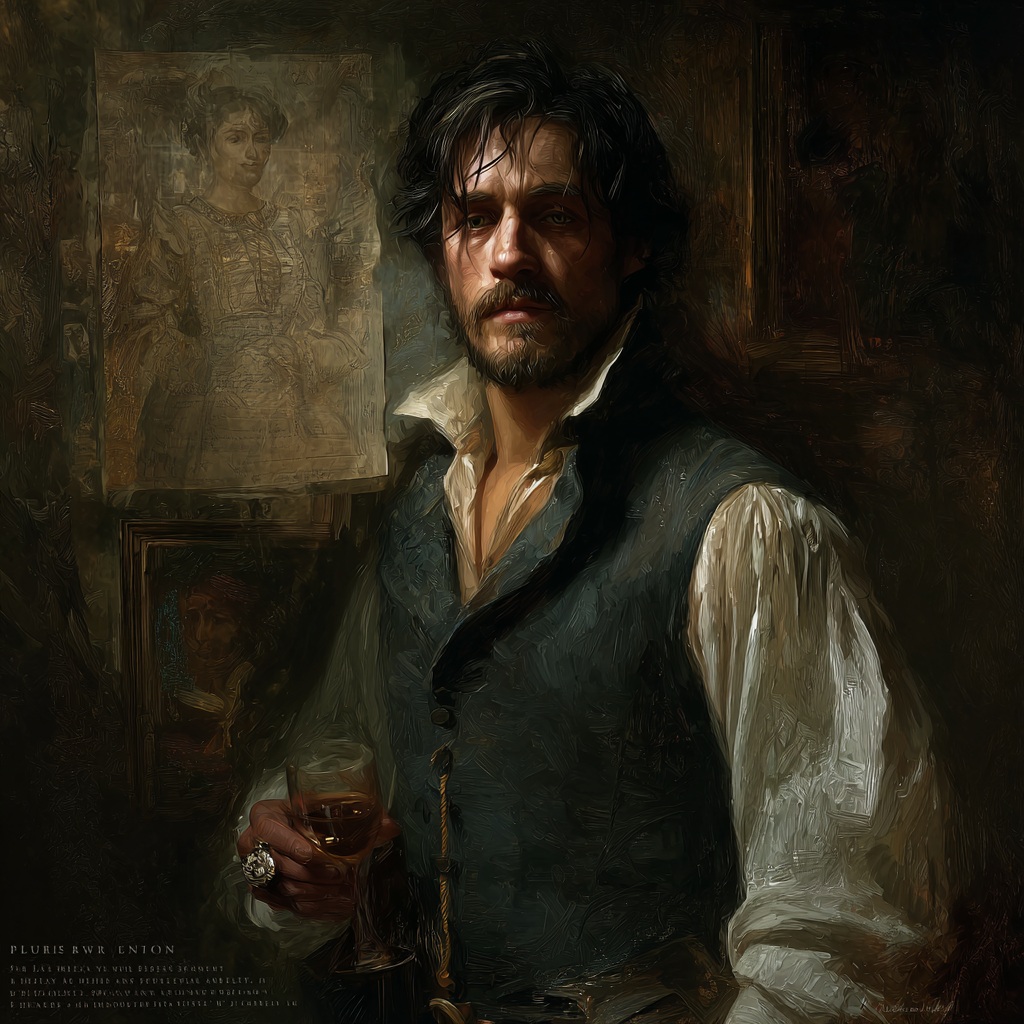
At night, he sits with a glass of Islay whisky, listening to old recordings — voices of those he once knew.
V. Nature and Appearance
Proud, well-read, and stoic beneath the weight of his curse.
Charismatic — a born leader, an art patron whose gatherings are legendary, yet whose heart remains hollow.
Warm, compassionate, and fiercely opposed to cruelty and injustice.
A scholar, a dreamer, and a melancholic soul who preserves the memories of his clan in diaries. To him, time is a material — to be shaped, polished, and bent like glass.
In galleries, he lingers before portraits and recognizes the faces of those he once loved and buried.
Alexander is tall and lean, his posture unbent by the centuries. His hair is dark, glinting silver in certain light — not from age, but from time itself. His eyes are storm-gray, like waves before rain.
He speaks slowly, every word deliberate, every silence heavy with meaning.
He wears little jewelry, save for an ancient signet ring bearing the MacDhùghaill motto: “Buaidh no bàs.” — Victory or Death.
His own words are simpler, whispered to the wind: “Tha an ùine dìreach bruadar eile.” — Time is but another dream.”
VI. The Curse and the Grace
He has learned that eternity is no gift, but a duty. So Alexander no longer wanders to flee, but to remember. In every century, he saves what might otherwise be lost — a song, a book, a painting, a name.
He says he is not immortal, only a keeper of what fades. And sometimes, when fog drifts across the sea, one might glimpse him at the edge of the cliffs of Skye — a man in a dark coat, gazing into the waves, as if reading the future written in the tide.
VII. Clan MacDougall
Clan MacDougall descends from Somerled, a powerful 12th-century King of the Hebrides. The MacDougalls are the senior branch of Somerled's royal house, named after his eldest son, Dougal (Dougall).